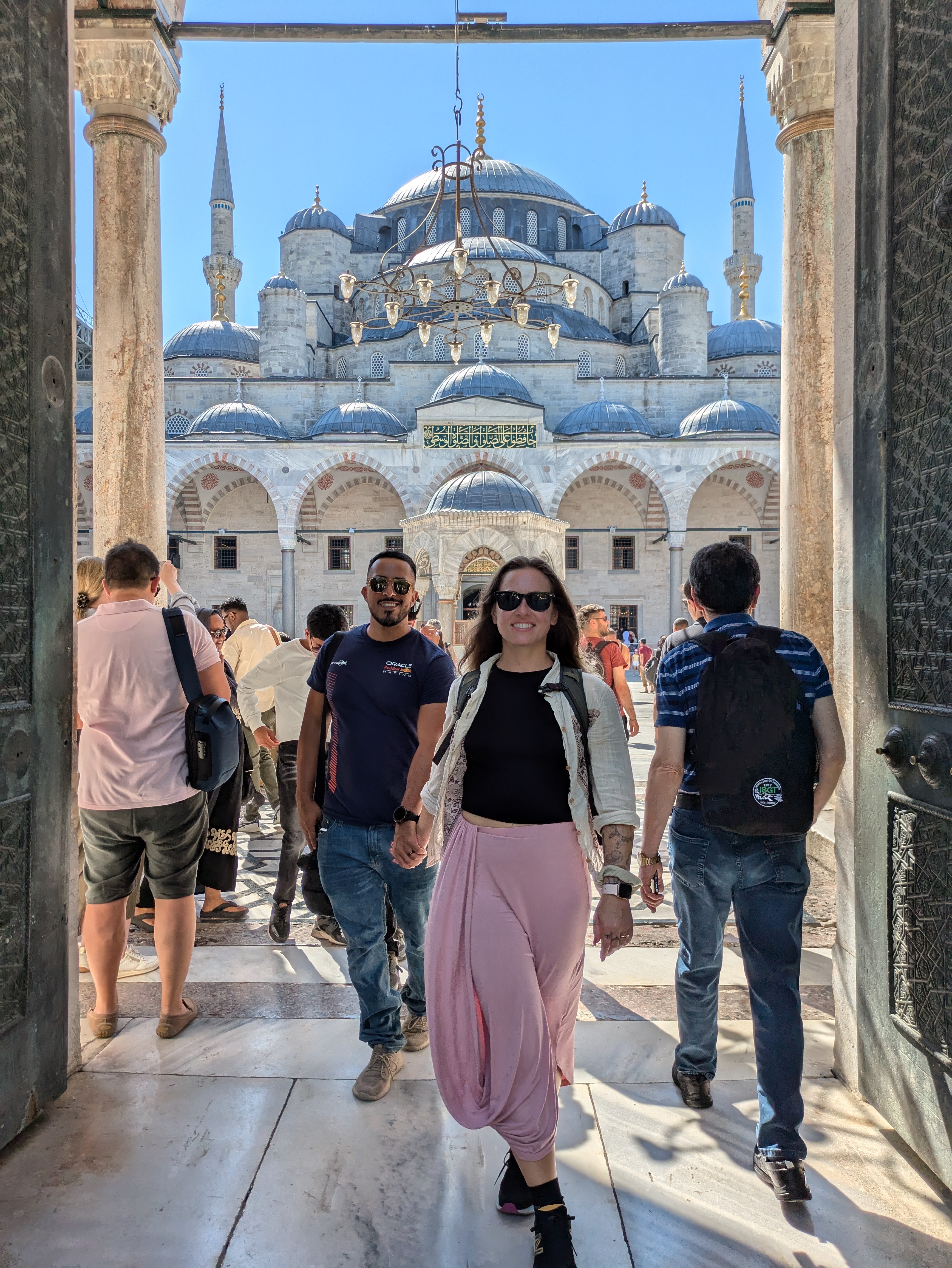
Istanbul was a whirlwind. I booked a three day private tour to see as much as possible with my limited time there. It is a beautiful city, but what I loved most was how alive it is. After dinner, we walked along the famous Istiklal Caddesi, adjacent to Taksim square. It was well after midnight, but we still had to navigate a bustling crowd of people to reach our hotel. And it was not the aggressive, intoxicated movement of young people jockeying for space as they moved from bar to club that I would expect at this hour. The hookah bars and regular bars were full to be sure, but mainly I was competing for space with couples and families strolling about. The stores and restaurants were still open as people shopped for clothes, ate dinner, or stopped for a decadent dessert.

Istanbul is known as “Where east meets west.” The part of the city we stayed in, which houses the historic center and Ottoman Empire palaces, is on the European continent. The other half of the city and the rest of the country sits on the Asian continent. The country is culturally Muslim. Our guide explained that some Turkish women wear scarves to cover their hair and some don’t. Most women wearing more than that are visiting from other countries. I carefully planned my outfits each day to be able to enter the mosques during the tour, making sure I was wearing a skirt that covered my knees and a top that covered my shoulders, plus a scarf to cover my hair. You can still enter a mosque if you are more scantily clad, but you will need to rent (sometimes free, sometimes not) clothing to cover yourself first.
On the second day of the tour, we visited Hagia Sofia. This was my first time ever visiting a mosque. Mosques are always free to enter, but the Turkish government had deemed Hagia Sofia both a mosque and a museum. Because of this, the government grants Muslims free entry to visit the ground floor, while non-Muslims pay an entrance fee for access to the second floor. Our guide lamented the stupidity of this, stating that it should really be one or the other, completely museum or completely mosque.
He was so against the system currently in place that he convinced us that it we should sneak into the Muslim side. I was nervous about the plan. Hagia Sofia is separated by gender, which meant I would also be separated from the guide. I didn’t know how to act once inside, nor do I speak Turkish or Arabic. But even if I did it’s not like I could ask the woman next to me what my next steps should be.

And there was something else that was bothering me. While I don’t have one myself, I have come to recognize the benefits of a personal spiritual practice. As a direct result of this, I am trying to be more tolerant of the least tolerant among us: religious people. Still, it’s hard to ignore the harm major world religions cause, on a individual and global level. At home in the western world, I have unfortunately come to expect the hypocrisy of (some, not all!) Christians praising their god in one breath and spewing hate and judgement against others with the next. They may say they love as their God does, but do they actually act like? I’ve seen it sometimes, but not often.
Annoying but tolerable, I can easily navigate any culturally significant Christian sites. I have visited the Christ the Redeemer Statue in Rio and the Vatican in Rome. Even if the larger implication tends to put me in a sour mood, I can always try to appreciate the architecture, the view, and the history.
I can roll my eyes and sneak a picture of the Sistine Chapel ceiling with my phone despite the numerous warnings to not do so. I already know the absolute worse case scenario is security asking me to leave or escorting me out. Embarrassing, but not dangerous, and not likely. What actually did end up happening was nothing more than being on the receiving end of a security guard’s wagging finger and despite the language and cultural barrier, in fact no words were exchanged at all, a look was served that was so disapproving it could only be interpreted as meaning I know you know you can’t do that here.
The problem with my current situation is that that I was in Turkey, not Italy. The religious site in question a mosque, not a cathedral. I had no idea what to expect and certainly no idea what to do. I grew up in a rural and almost completely white and completely Christian area. It was during the aftermath of the attacks on the World Trade Center that I first even heard of Islam. I had never met a Muslim person in my life. All that the Christian religion had taught me was that other religions, any other religion, was bad. Even curiosity about other kinds of people and their faith was dangerous.

Because of all of this, all that I knew of Islam was dangerous extremism. Osama Bin Laden was the boogey man of my generation. Late at night I would scroll through the Wild West days of the early internet. And in the midst of the absurd and the strange I would occasionally unearth all manner of things I should never have seen. This included violent images and videos of suicide bombings and beheadings.
As I prepared to enter Hagia Sofia, all of this loomed up from the back of my mind. Something I hadn’t thought about in decades, much less processed. And I felt uneasy. I don’t care about breaking rules but I do care about getting caught and getting in trouble when I don’t know what the consequences are. Of course, I met Muslims and people that are culturally Muslim as soon as I ventured out into the world as a young adult. And I have been to Islamic countries before. Turkey is probably the least conservative Islamic country existing today. And Istanbul caters to tourists from all over the world.
My fear was based purely on my own ignorance. Some of the discomfort and uncertainty I was experiencing stemmed from a fear of violence that was irrational and based on nothing more than my own lingering, unprocessed Islamophobia. However, I was also dealing with a very rational fear that haunts me whenever I venture out into the world. The fear of inadvertently being a rude American. And pretending to be Muslim certainly felt disrespectful.

But my desire to skirt religious rules and not give money to any organized religion won out over all my fears. I carefully covered my hair and tried to cover my tattoos with my scarf. With my head down, we walked through the entrance for Muslims and the guards stopped me immediately. The guide stepped in and had a brief but seemingly heated conversation with the official before they let me through. As we walked away, he was indignant. What does a Muslim look like? He wanted to know. They can’t tell you what is in your heart. If you say you are Muslim, how dare they question you. So it appeared that I wasn’t the only one who not only didn’t care for religion but took serious issue with it at Hagia Sofia that day.
After that, I was on my own. The guide went with my husband to the men’s section. I ventured to the women’s, casting furtive glances at those around me, waiting to be expelled from the grounds. But no one so much as looked in my direction. Busy having their own vacation, no one seemed to notice me at all. I had no idea what the next steps were. Aren’t I supposed to wash my feet or something? I wondered.

I took off my shoes and passed through the doors to the main part of the mosque. And it was . . . Just like any other church. It was literally the same thing I had been less than impressed with all my life. In fact, the Byzantine empire originally constructed Hagia Sofia as a Christian church. The Ottoman Empire converted it into a mosque in 1453 when they conquered the city. Sure, the architecture and decoration was a little different but it carried the same feeling as any church I had ever been to. Nothing scary, nothing mystical. Nothing really different. Just a pretty space with a reverent atmosphere.
I walked the carpeted floor, observing the art on the ceiling. It was quiet, visitors spoke to each other in hushed tones. There were women milling about and women with their young children sprawled on the floor, stopping to take a break amidst a full day of tourism. I spotted another interloper, a tomcat, that was milling about lazily to escape the heat for a bit.

Upon recognizing that I truly had nothing to be worried about, it wasn’t exactly shame that I felt. It was the realization that I had unconsciously confused reverence with fear. A tale as old as religion itself. As a result of not processing this, and because of my fear of the unknown, I had convinced myself that the world was a scarier place than it actually is. This not only limits myself and my world view, but contributes to a society built on fear of the unknown. This experience reminded me that it is my own responsibility to educate myself about the reality of the world. And while striving to respect the culture and beliefs of religious individuals is a noble goal , it doesn’t preclude me from experiencing distain for the industrial complex of all major world religions, equally.


Leave a Reply