Table of Contents
A Graffitour of Comuna 13: Present Day
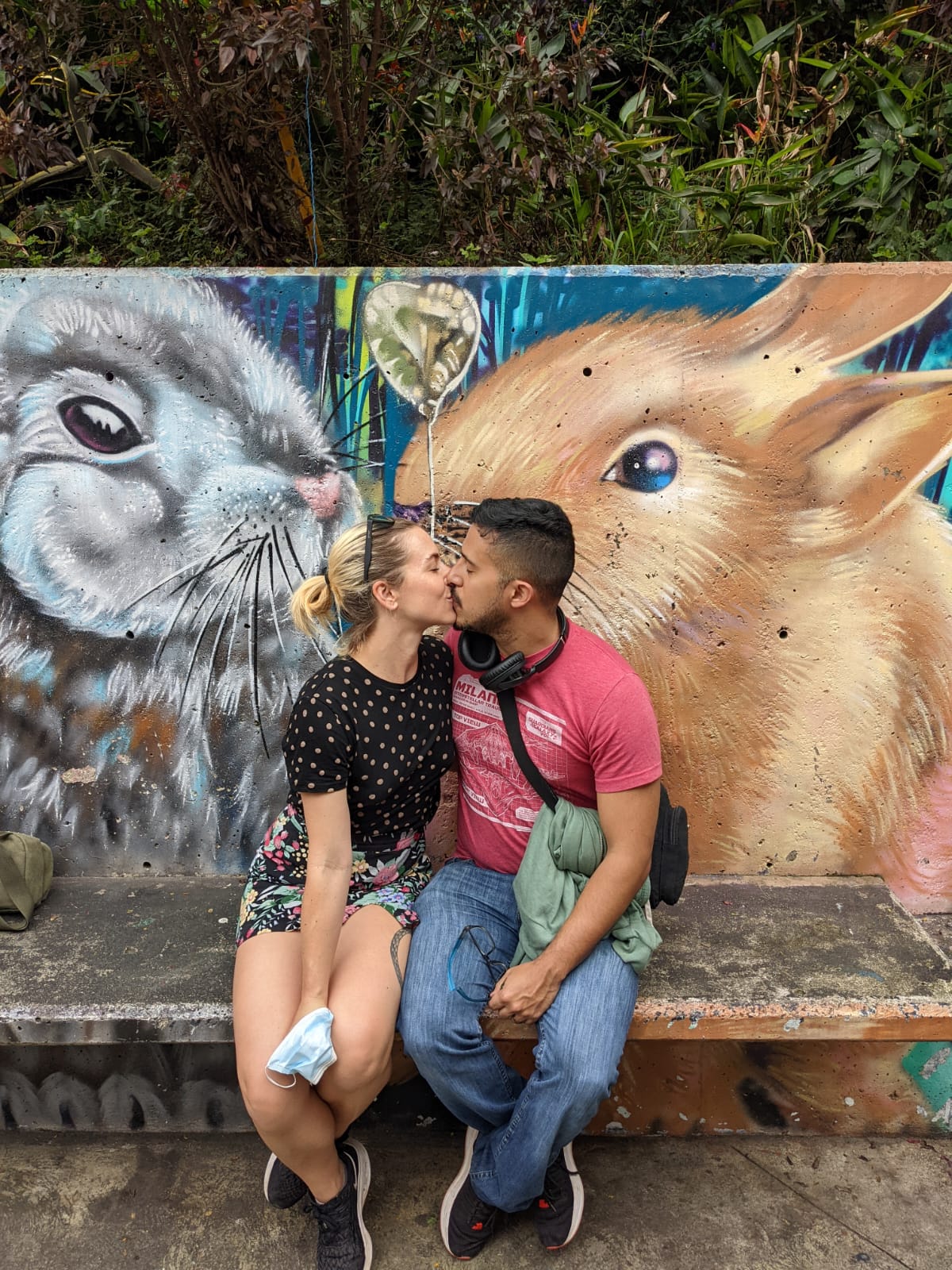
I first heard of the iconic Medellín neighborhood Comuna 13, also known as San Javier, by way of a friend’s post on Instagram. And at first glance, it is a place that seems created specifically for tourists to come to take pictures. Graffiti and murals in all different styles cover the main streets of this hilly neighborhood. The area is easy to access from the city center of Medellín by metro, and although it is a steep climb to walk through the neighborhood, there are escalators to make it more accessible.

We booked a guided tour from a local who met us at the metro station. From there we boarded a bus together and arrived at the bottom of a series of switchbacked streets signaling the start of the Comuna 13 neighborhood. We began our ascent, stopping for photos as our guide pointed out the significance, politically or artistically, of different murals. Vrious street performers played music, break dancing and rapping along the main street. We bought some hormigas culonas, literally “big ass ants” to eat because we are adventurous, and washed it down with the much more palatable mango ice cream with lime and salt, which is also typical of Comuna 13.

I couldn’t find hardly any information online before arriving. Anything that I did manage to find could be summarized into the same two lines:
Comuna 13 was one of the most dangerous neighborhoods in the world in the 1980s and 1990s. Now the area has been completely transformed into a safe community and world class destination thanks to the healing power of the arts and tourism.

Our guide, a 3rd generation native of Comuna 13, gave more color to the story. He told us his personal accounts of growing up in the 2000s in a perilous balance, specifically pointing out an alleyway that was notorious for killings as we walked by. In-between photo ops, he spoke of surviving Operation Orión, and pointed out the dump, where the bodies of disappeared and executed community members remain un-excavated in mass graves to this day. He discussed how the neighborhood had changed as the violence dissipated and Comuna 13 became an arts filled neighborhood, and later a tourist destination.

After the tour, there were still gaps in my understanding. I lacked a basic knowledge of the history of the city of Medellín and Colombia in general. Periods of peace and conflict and the changing power structures across Colombia over the decades all contributed to the microcosm of the story of this particular neighborhood.
What caused these changes to actually unfold? Of all the places in Colombia, why was Comuna 13 such an epicenter of violence and conflict for so long? Why did the violence subside? Why would the government take a sudden interest in investing in the infrastructure of an area that they neglected for so long? How did the murals originally start?

I began to dig deeper, and it surprised me how difficult it was to find reliable information, especially in English. There were many conflicting and false narratives, and actual numbers were even harder to track down.
I decided to write the story that I was able to piece together here. This post is for my fellow future tourists who could also benefit from learning the history of Comuna 13, how the area was actually created and transformed. This is a starting point. It is not a replacement for understanding Comuna 13 from the people who live there. This is meant to function as some background reading to get you up to speed before you go so that you can have more context and ask informed questions, in order to get the most out of your visit. Because Comuna 13 is more than just a place for tourists to come, take pretty pictures, and forget about.

A note on language: I use guerrilla groups as an umbrella term to refer to refer to leftist communist groups in Colombia such as the FARC (Fuerzas Armadas Revolucionarias de Colombia, Revolutionary Armed Forces of Colombia). I use paramilitary as an umbrella term to refer to right-wing groups such as the AUC (Autodefensas Unidas de Colombia, United Self-Defense Forces of Colombia).
Comuna 13 through the 1970s

Medellín consists of 16 numbered districts, or comunas. Farmers and laborers hastily built the poorest districts into the less desirable, steep hillsides surrounding the city center. Comuna 13 is just one of many such districts, located in the western outskirts of Medellín. In postcolonial Colombia, the area originally functioned as farm land. It was later was converted into cooperative housing for farm workers.
This housing grew into a slum during the 60s and 70s due to a sharp increase in the population over a short period of time. This follows a migration pattern typical throughout Latin America of rural to urban migration during these decades. Workers came to city centers seeking better employment opportunities. In Colombia, armed conflict exacerbated this movement. The violence between the newly developed leftist and communist groups and the right wing Colombian government, whose military efforts were backed by the United States government and the CIA. occurred primarily in rural regions
La Cuna de Pablo Escobar: 1980s-1993

By the late 80s and through the 90s, Comuna 13 was known as as “La Cuna de Pablo Escobar” or “The birthplace of Pablo Escobar.” It was also known as one of the most dangerous neighborhoods in the world. Comuna 13 is strategically located to the west of Medellín. It also developed without planning, and contains many narrow streets and alleyways. This made it a prime location for Escobar to traffic drugs and guns to and from Medellín. Because it was such a lucrative area, it became a main focal point of the conflict between the Medellín Cartel, guerrilla groups, the Colombian army, and paramilitary groups. Guerrilla groups took control of the area after Pablo Escobar’s death in 1993.
Guerrilla control and Operation Orión: 1993-2002

Comuna 13 remained a source of violent conflict between the different factions in Colombia. As the FARQ grew more powerful, the Colombian government grew more concerned with guerrilla activity. After a series of escalating advances on Comuna 13, on October 16th, 2002, the Colombian army launched an infamous offensive called Operation Orión.
The sources I found state that the government dispatched anywhere between 1000 and 3000 soldiers and military police. The offensive included the use of military grade tanks and helicopters. It is important to remember that this was a densely populated civilians area, and the offensive resulted in many civilian casualties. The heavy combat lasted several days, until the government forces expelled the guerrilla groups from the area.
Reports vary widely, but it is estimated that during Operation Orión and the turbulent period after, when the Colombian military withdrew from the area and paramilitary groups took control of the neighborhood they tortured 10s of people. Paramilitaries executed approximately 70 people. Between 50 and 300 disappeared. They illegally detained around 450 who without trail. They forcibly displaced between 2,000 and 3,500 people.
These numbers are an estimate due in no small part to how the paramilitary disposed of bodies. They created a mass grave in a dump site called la escombrera on the hillside of Comuna 13. The Colombian government refused to excavate the area for decades. This left the families of hundreds of victims unable to find closure, unsure of the fate of their relatives, even though it is easy to see the site from the main streets of Comuna 13. After decades of protests and political pressure, excavation of the site finally began in July of 2024.
Donbernabilidad: 1993-2008

While guerrilla groups were controlling Comuna 13, Diego Murillo Berjarno, alias Don Berna, was consolidating power in Medellín. A major figure in the world of organized crime, he had risen to take the place of Pablo Escobar as the leader of the most powerful cartel in Medellín. He had absolute control of the city. This period was known as “Donbernabilidad,” a play on his alias and the Spanish word for governance, gobernabilidad.
He was also part of the AUC and became the leader of his own AUC faction in 2000. Negotiations between the Colombian government and Paramilitary groups with the stated aim of demobilization starting in July 2003. Paramilitary groups withdrew from Comuna 13 shortly after.
The government arrested Don Berna in 2005 but he continued to function as a powerful cartel leader until his extradition to the United States in 2008. This was part of a deal that included 13 other paramilitary warlords, most of whom were also high profile drug cartel leaders.
The Orange Economy vs Dark Tourism: 2008-now

With Don Berna extradited, the city was left with another power vacuum. This time, cartels and local gangs fractured and fought for control. During this same period, the local government began investing heavily in urban renewal projects across the city, focusing on the neglected infrastructure and public transportation of the poorest neighborhoods. One such project was the building of a cable car system, which arrived in Comuna 13 in 2008. These cable cars cut commuting from the edges of the city to the city center down from several hours to 30 minutes, allowing for easier access to gainful employment and higher education.
The government built the famous escalators of Comuna 13 in 2010. This was actually not to promote tourism but as part of a project to increase access for the elderly and residents with limited mobility living on the steep hillside. Then mayor of Medellín Alonso Salazar, and the city’s Urban Development Company spearheaded the project.
During this same time, the “orange economy” or creative economy, was developing in Comuna 13. The local community created this economic model despite the lack outside support, or more accurately because of the lack of support for economic development in the area. Despite improved infrastructure and access to higher education, employment opportunities outside of illegal activities remained rare.
Artists began forming collectives and groups to promote and sustain their art to generate revenue. Locals have used artistic expression throughout the history of Comuna 13 as a means of processing and coexisting with decades of brutal conflict and violence. Among many other forms of artistic expression, murals, break dance, and hip-hop have become emblematic of Comuna 13 today.
It is important to note that Comuna 13 is not a place for “dark tourism.” It is not an area that glorifies Pablo Escobar or the violence that has occurred. The message from the people that live there, one that is clearly reflected in the art that is on display in every corner of the neighborhood, is one of transformation, remembrance, and the resilience of the community.
Sources
https://www.artdependence.com/articles/hi-im-chota13-from-commune-13-medellin/
https://www.axios.com/2023/02/07/medellin-mass-transit
https://www.brookings.edu/articles/reducing-urban-violence-lessons-from-medellin-colombia/
https://colombiareports.com/amp/medellin-operation-orion/
https://insightcrime.org/investigations/colombia-elites-and-organized-crime-don-berna/
https://www.mieocolombia.com/comuna-13-simbolo-de-transformacion/
https://opca.uniandes.edu.co/espacios-de-memoria-el-caso-de-la-escombrera-en-medellin/
https://la.network/el-graffitour-de-la-comuna-13-motor-social-y-creativo-de-medellin-para-el-mundo
https://www.semana.com/nacion/articulo/medellin-estrena-escaleras-electricas-comuna-13/251323-3/
https://en.wikipedia.org/wiki/CIA_activities_in_Colombia
https://en.wikipedia.org/wiki/Colombian_conflict
https://es.wikipedia.org/wiki/Guerra_urbana_en_la_Comuna_13_de_Medell%C3%ADn_(2001-2003)
https://es.wikipedia.org/wiki/Operaci%C3%B3n_Ori%C3%B3n
https://en.wikipedia.org/wiki/Right-wing_paramilitarism_in_Colombia


Leave a Reply