One of the main reasons why I enjoy dancing these days is for the social aspect. I love that it brings together all types. I get to meet all kinds of people I would never normally come into contact with. We may have nothing else in common, but we all love to dance. This is something I touched on briefly in a post all the way back in 2018. Back then, my dance life looked nothing like it does now. Dance was my life, and I was training seriously. I was taking private classes and going to special events called dance congresses as often as possible.
Dance congresses are events that span a weekend and typically extend to three of four days total. The largest congresses are in hotels with those cavernous conference rooms that organizers can endlessly reconfigure using thin panel walls that slide and are suspended from metal tracks in the ceiling. Volunteers, in exchange for a free pass, carry in platforms for the instructors to stand on and a smooth surface to dance on in small squares that they then diligently fastened together piece by piece.
Instructors from all over the world teach classes during the day. At night, the dancing starts around 11 pm and extends into the early morning, typically until 6 am or even later. Or at that point, I might as well say even earlier. There are hundreds of people that attend, often over a thousand people. I know people that will fly literally across the world and not step foot outside of the hotel if it is a good congress. It’s an exhausting, exhilarating, and completely unique experience.
These days, I still love to dance. I am no longer “in love” with it, but we remain good friends that run in the same social circles. I am much more casual in my dancing. Occasionally, I still take a class or go out for a night of dancing. But more often than not, I would rather get a good night’s sleep if I am being completely honest.
I love the way a friend a mine once described it. When he announced that he was walking away from being a dance teacher after many years, he said that dance is like a river. The exact form and flow of the dance community will shift over time. Individual dancers will come and go. Sometimes it is so crowded that dancers on that dance floor that couples will crash into each other with the same frenzied energy of raging rapids. Other times it will be a drier season. The water is always changing but it’s still the same river, and it’s still the same dance. When I first fell in I was swimming in the middle of the current and struggled to even come up for air. These days I tend to just dip my toes and keep walking.
This trepidatious wading took the form of salsa dancing while I was still living in Atlanta. It was during one such a class that I met my friend, Manuel. He was studying aeronautical engineering at Georgia Tech on a student visa from Spain. He was also the friendliest person in the class. I would see him at socials and we started talking. It is unlikely that we would have crossed paths in any other setting. He is just one example of the many varied friendships I am grateful to have collected over my many years of dancing.
And when I was on my what I will hear after refer to as The 2023 European Nini Tour That I Had No Real Business Being On, Manuel was home in Madrid visiting his parents for winter break. I had never been, so I decided to add another stop to my itinerary to eat some tapas and take in some history.

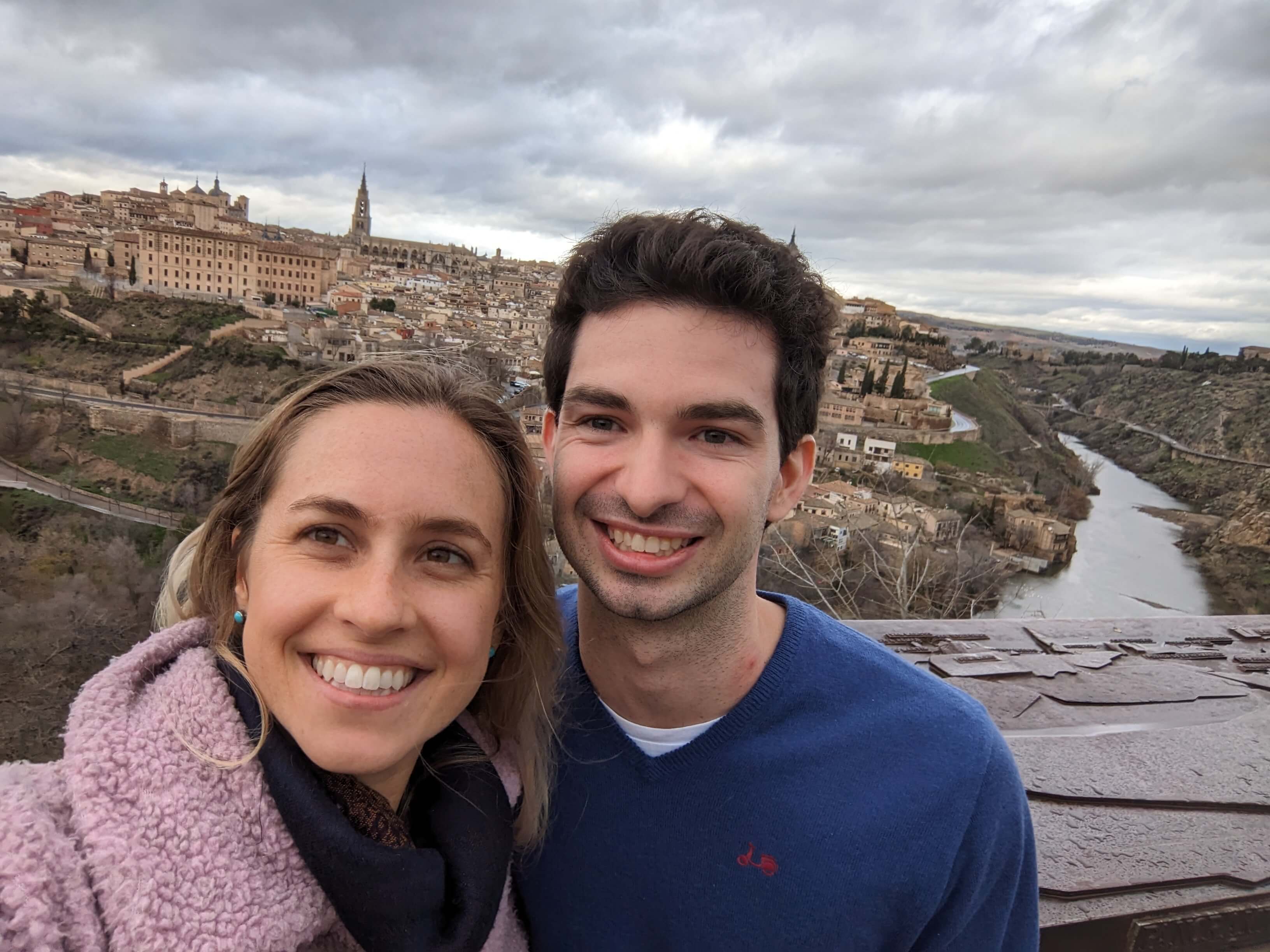
Manuel took me on a day trip from Madrid to Toledo. Toledo was the original capital of Spain, taken over from the Moors by King Alfonso VI in 1085. As an American, I always struggle to comprehend history on this sort of scale. In my mind, witnessing a building older than 200 years is a marvel. And here I was, trying to contextualize the past 1000 years which caused me to kind of short circuit.
When I first started working all over Latin America, I quickly realized that my vocabulary is laden with words only used within Mexico. A consequence of living there and learning Spanish almost entirely informally. The problem was, I had no idea which words were more “neutral” or universally understood Spanish, and which were distinctly part of the Mexican lexicon. Casual conversation with coworkers turned into a ticking time bomb as would say botanitas for snacks or mande? for what? and people would laugh or not know what I was talking about.
Toledo is known for its marzipan. The main square was peppered with quaint pastry shops. Each shop had displays filled with the confectionary that pastry chefs formed into delicate and brightly colored animals and other whimsical shape and then neatly arranged on row after row of plastic trays. I was trying to remember if marzipan was made from almonds or peanuts and kept using cacahuate instead of the Spanish mani, a word I had never heard before.
In retrospect, it seems obvious that the word cacahuate has a Nahuatl (Aztec) etymology, especially considering the peanuts are originally from South America and were cultivated in Mexico by the time the Spanish arrived. My friend nodded politely for several minutes as I was talking before eventually admitting that he had no idea what I was on about.

We took a walking tour of the city center and visited the church before heading back to Madrid. I was staying in the center of the city, in a gorgeous and ancient seeming building that must have originally been a manor of some kind. Later an industrious landlord carved it into single floor apartments. The one I stayed in now functioned as an airbnb with individual rooms.
I wanted to go to the bull fighting arena. I couldn’t stomach an actual bull fight, nor would I want to. But I was curious to see the building and understand the culture around it. However, when I told Manuel my plans he seemed so disappointed that his reaction convinced me not to go.
Instead, I participated in one of my favorite activities while traveling to a new city. I took a bike tour. We stopped at the most notable of the many plazas and parks throughout Madrid and the royal palace. I always enjoy this type of tour but the caliber of the tour itself is basically complete dependent on the guide and the weather. I was fortunate that both were excellent this day. The tour guide was a young history major who gave the group lessons on the various waves of ruling parties that had taken control of the country throughout the centuries.

I learned that the Iberian peninsula was under German control after the fall of the Roman Empire. In the early 700s the Moors took over as part of the expansion of the Islamic empire. This lasted a few hundred years until our friend Alfonso showed up as previously mentioned. Then it was back to a German way of doing things in the 16th century with the Habsburgs. They remained in power through the height of Spain’s influence until they inbred themselves incapable of ruling by the year 1700.
As I had planned, when I wasn’t learning about history, I was eating. I love all kinds of food. But the Iberian peninsula takes the cake in Europe for me. I love Spanish food and the cultural around eating. Having a light breakfast of toast and puréed tomatoes. A late lunch and even later dinner. The mediterranean diet using fresh, simple ingredientes. Sharing tapas, wine, and sherry with sparkling water. Starting the party late and staying out until breakfast the next morning.

My stay in Madrid was short and sweet. I loved it because everything was new. I experienced new places and learned something new about the history of Spain. Even more importantly, I got to try new food. And of course, my favorite part was getting to spend some time with a new friend. It reminded me that friendships, like interests, will ebb and flow throughout a person’s life.
Leave a Reply