One true pleasure of living on the East Coast, of which there are markedly very few, is the easy access to Puerto Rico from most major airports. New York, Atlanta, and Miami all offer direct flights multiple times per day, and often for a very low cost. It is close enough for even a quick weekend getaway. It offers the same type of escape as Hawaii offers the West Coast. In my mind, Hawaii shares the dramatic landscape of the West Coast. The Atlantic influenced both with its violent and wild temperament.
Hawaii achieves its impressive peaks through chaotic volcanic explosions. Similarly, the Pacific Coast ranges characterize the West Coast. A series of towering mountain ranges, formed recently, in geological terms, as tectonic plates continue to crash violently into each other. The Sierra Nevadas shot up due to this seismic collision course a mere 40 million years ago, making them still in their prime in geological terms.
Compare this to the Appalachian Mountain range. It is beautiful series of mountains that stretches its way north to Canada all the way down south to Alabama. It includes the Great Smokey Mountains and the Blue Ridge Mountains. 300 million years ago, the same geological forces formed this range. But after so much time, the wind and the weather have taken their toll. Now these hills look like stubs when compared to their younger counterparts to the west.
Move a little further east from this mountain range and you will find yourself with the Atlantic gently lapping at your feet. Gentle except for hurricane season in the fall. A not-so-small price to pay for all this warm water to be enjoyed the rest of the year. This feeling cultivates into a tropical Caribbean breeze by the time you make it all the way south to Puerto Rico. Here, the gentleness of the east coast is mirrored in this island as well.

When visiting either island, if you are anything like me, you may feel the need to Google, just to make sure, that that you don’t need your passport before taking off on your tropical vacation. There is one major difference of course. Hawaii is one of the states that make up the United States of America, and Puerto Rico is a territory. Because of this, citizens of Puerto Rico do not have the same rights as U.S. citizens. They cannot vote in presidential elections and are not represented in the federal government. Referring to it as a territory is a way of glossing over the fact that it is one of the five permanently inhabited locations currently functioning as a colony of the United States.
If you are American, you don’t need a passport, and you don’t need to exchange currency. USD is the currency of the island. English and Spanish are both official languages, although Spanish is predominant. Outside of the capital city San Juan, I saw paper flyers advertising English classes.
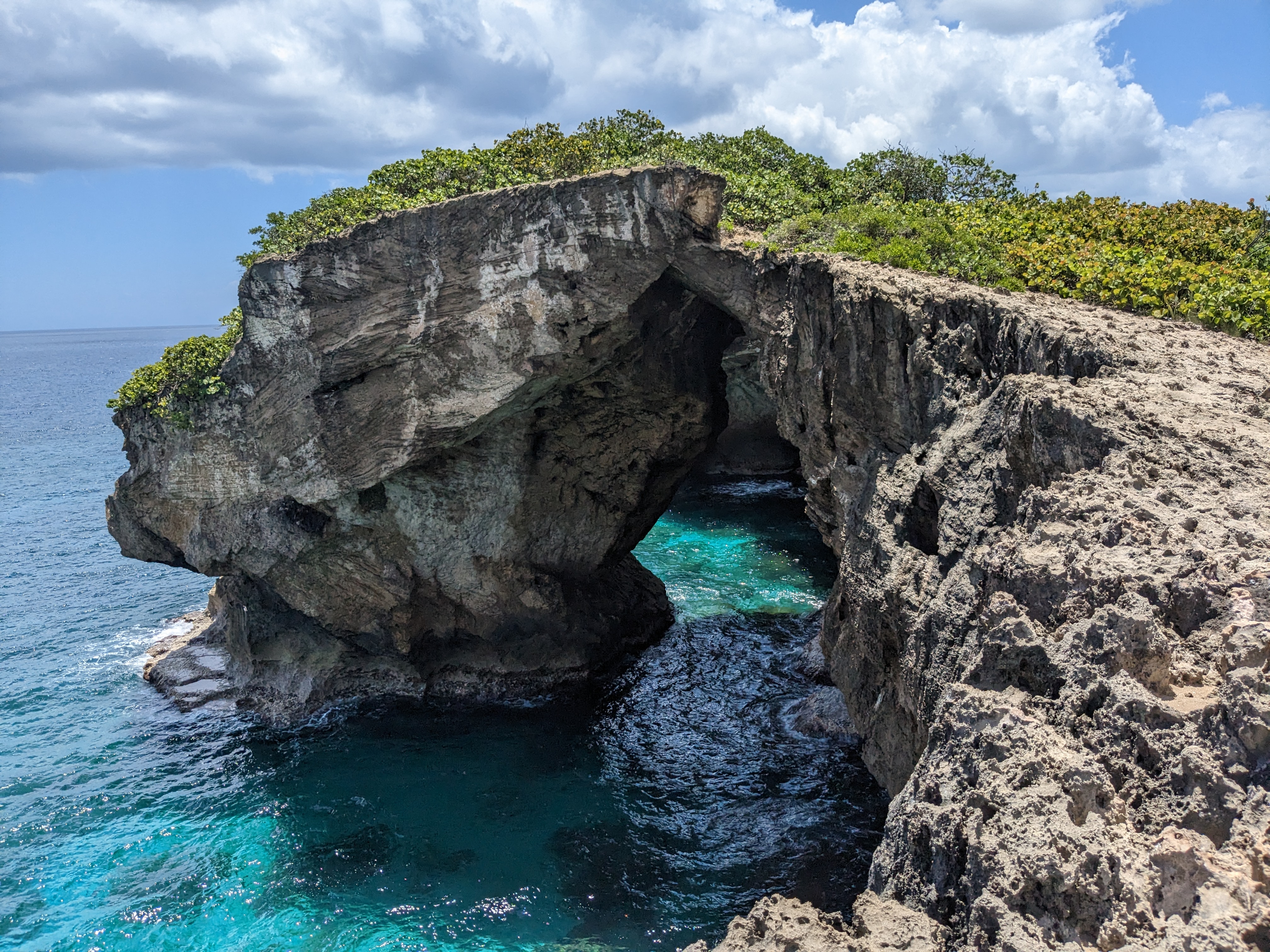
We arrived in Puerto Rico for a long weekend in June. To begin our journey we left San Juan early in the morning, heading west along the highway. Our destination was just a short drive away to Cueva del Indio. The cave is part of the public coastline. You can park for free by the side of the road and find the cave on your own. However, locals advised us to pay the parking fee and minimize the chance of someone breaking into our car.
We pulled into a sandy lot by the shore. We crossed the lot to a small rickety table under the meager shade of a plastic tarp. The sun was brutal. The sun bleached everything white with a punishing light. A portly man was guarding the entrance, selling tickets and bottles of water and short on information as to what we had actually come to see. He gestured vaguely, telling us to follow the path and we would see it on our left.

Calling it a path may have been an overstatement. We followed a light trail that could be considered a path before it split several times and disappeared. We had to wander back and forth before happening across someone giving a private tour who pointed us to the actual entrance of the cave. It is objectively not a difficult climb to actually get into the cave. But it did require some scrambling and was a tight squeeze. It was enough to trigger my climbing-related anxiety. My legs started shaking uncontrollably at one point but I managed to power through. The entrance opened up to show the cavern itself. The light filtered through the rocks to take on a more gentle glow.

We continued our journey westward, taking a detour to visit the Arecibo Observatory. It is the home of the Arecibo Telescope, a radio telescope built in 1963. It boasts an impressive 1000 ft diameter and was the largest of its kind until 2016. The site of the telescope takes advantage of a natural sinkhole that the satellite dish was built into. As well as to take advantage of Puerto Rico’s proximity to the equator. The telescope confirmed the existence of neutron stars among other celestial objects. The telescope collapsed in 2020 after suffering hurricane damage. The site remains open to the public. And, the large volume of data collected during the telescope-s years in operation continues to be analyzed.

We wandered up a steep mountain covered in lush vegetation. At the top a small white building greeted us. The darkened windows made it impossible to see inside. We bought tickets for the next tour of the facility and hung out inside the small museum for about 20 minutes waiting for our tour to start. We perused exhibits, mostly for children, on how telescopes work and various topics on space. There was a large collection of shards of meteors, all discovered using the telescope.
When it was finally time to see the thing itself, it was both impressive and underwhelming. A bored teenager walked us outside, which was the entirety of the tour. We saw the huge expanse of white metal which composed the satellite bowl itself. There are four towers in varying states of decay, a testament to when it was still functional.

By the end of the day we arrived in the small town of Aguadilla. We found a hipster cocktail bar and headed out for the evening. We were celebrating and proceeded to get tipsy. After dinner, we asked the server if they could help us get a taxi. To her and our dismay, she replied that there were no taxis in this town. Shocked at how far we had traveled culturally from San Juan with such little distance, we wandered down to the beach to wait to sober up. Soon enough, we came across an open market with salsa music playing. We danced in our flip-flops to the music and eventually waited by the beach, watching the waves in the dark.
The next day we arrived in Ponce, the second-largest city in Puerto Rico. We tried to tour around, but there wasn’t much to see. So we visited the Don Q rum distillery. This ended up being a private tour. And as anyone could have guessed but I did not, a booze tour. Our tour guide offered us about 5 rum drinks over the next two hours as part of the tour, despite the 11 am start time.

We learned that the distillery was once a sugar cane plantation. The owner of the plantation was immigrant from Europe. When the sugarcane business went south, he started the distillery. After becoming successful, he returned home to Europe and was never heard from again. This left everything to the wife and children he had made in Puerto Rico. Originally, all of the ingredients used in the rum came from the plantation. Now, Don Q imports the sugarcane and the barrels. Only the water is local.

After the tour, we traveled on winding roads that curved through the lush jungle. I thought they had to be one way because they were so narrow, but around every other corner, a delivery truck of one sort or another would come barreling towards us at full speed. I would resist the urge to run the car off the road to make space. We drove a path straight up through the island to get back to our starting point. Back to San Juan, and back to what is a completely other kind of America.
Leave a Reply