Learning a new language is embarrassing. I took Spanish in high school and college but I really didn’t get it. And while I can be quick on some things, the idea of verb conjugation itself took me about two years. So, as you can imagine, it was an uphill battle. In the months leading up to coming to Mexico City, I plodded along through a “Spanish Grammar Made Easy” workbook and daily Duolingo lessons. And let me tell you, reading a grammar book by yourself is not the way to learn a new language.
When I first arrived in Mexico, I could not understand anybody and nobody could understand me. I walked around terrified that someone would ask me a question and mumbled my words because I was self-conscious about everything I was saying. And with good reason, I sounded like a total idiot. An extremely limited vocabulary, horrible pronunciation, and lag-time from translating in my head aside, I had no idea what I was doing.
I would accidentally misuse expressions or totally botch words before being corrected by a polite stranger or (much more common) made fun of in an oh so good-naturedly manner by my friends, who after laughing at my expense for much longer than I think was necessary before explaining the error would then later feel the need to tell other friends that weren’t present what had happened so that everyone could participate in the ceaseless merriment I brought to those around me.
Most people in Mexico City speak at least some English and there are many foreigners that have lived here for years and speak almost no Spanish. And it’s easy to see why. It’s hard to learn. I, however, had come to Mexico in part to learn Spanish and did not want to be that particular kind of asshole, the kind that lives in a country and doesn’t learn the language. So when I wasn’t working, I tried to not speak English at all for the first six months. I listened to Coffee Break Spanish and Spanish Obsessed during my commute and kept a diary in broken Spanish.
And I was very, very lonely in a way that’s hard to describe. Not only was I in a new, extremely large city, but I was only capable of having really boring conversations. I couldn’t express myself beyond basic needs. Any topics involving expressing opinions or emotions was beyond my reach. How could anyone get to know me? And how could I get to know anyone if I only knew how to say icebreakers? How are you? What do you do? Where are you from? Who cares?
In a city of 20 million, I was literally surrounded by people and I was totally alone. The sidewalks are always crowded, the metro is always crowded, the markets are always crowded. I watched for body language and would respond in kind. I would watch people to learn how to buy groceries, how to pay at a restaurant, how to get on a bus.
I learned to be in groups and just look around, unable to follow the conversion. I would laugh just a split second after everyone else had laughed. I learned to just say yes or no and hope there were no follow-up questions.
I was lucky I had dance. I was able to meet a lot of different people and not really be expected to talk. And slowly, I was able to start speaking in a way that makes human interaction worthwhile. Now, when I see someone I haven’t seen in a while, they always want to know how my Spanish is coming along. And when I respond using slang, they are always surprised and tell me how advanced I’m becoming. And this makes sense. You don’t learn a language from a book or being in a classroom. You learn it by having conversations with people. Seems obvious, but the only way you can learn how people actually talk is the most terrifying and vulnerable option, by talking with them.
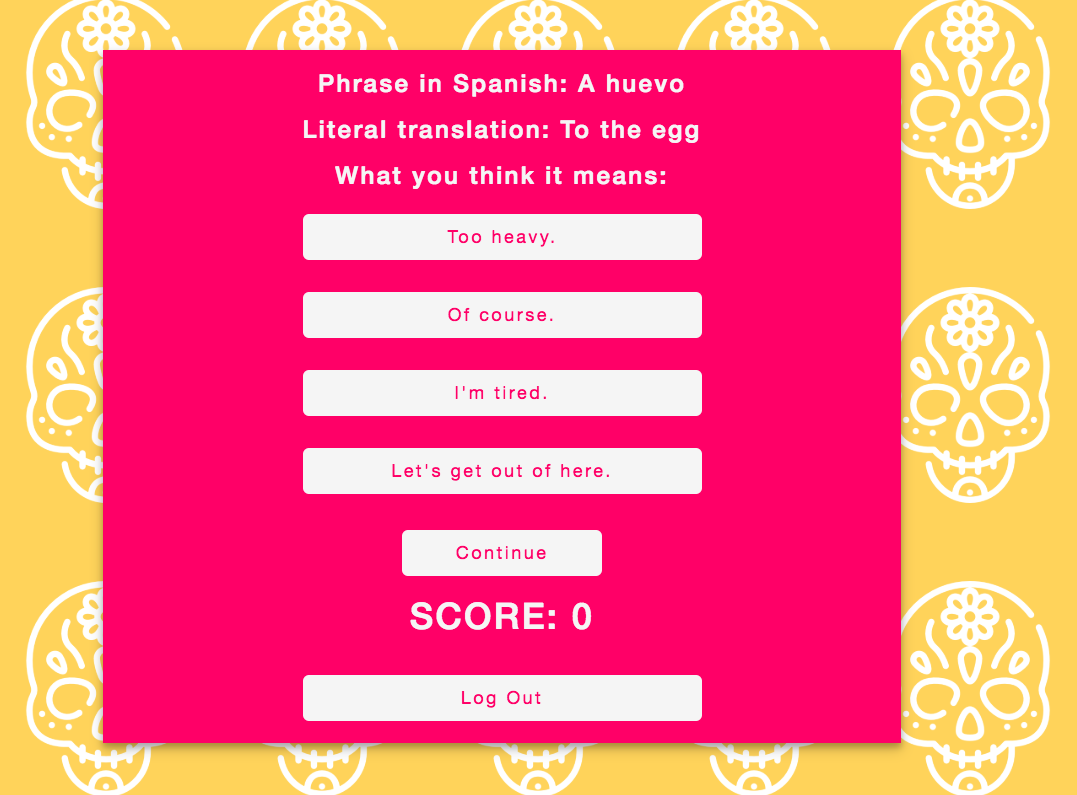
So, with that benchmark in mind, I created a game. It’s like any other language learning game but instead of regular vocabulary, I decided to take it to the next level and used slang words and expressions from Mexico City. The user is presented with the expression in Spanish, the literal English translation, and options for what they think the actual meaning of the phrase is. I called in chiSLANGo in reference to chilango, the slang term for someone that has moved to Mexico City.
And while it’s no substitute for the real thing of getting out and talking to people, it will help prevent you from asking what the hell are you talking about the first time you hear someone say que pedo. You can check out the game itself (in all it’s unpolished glory, finishing touches coming soon) here.

Leave a Reply