I started being active with this blog again a little over one year ago, and am proud to say I have faithfully published at least once a month. As I touched on when I first started this blog in 2018 and in the more recent Why have I been gone?, existential dread is something that I often struggle with in a real, debilitating way. I have this constant gnawing feeling that something is missing. That I am somehow misaligned.
My life path can look adventurous, but it is just as easy for me to label it as directionless. However I have always craved financial stability, and I let that be my north star. I went about fulfilling this need with all the external trappings of success. This took a long time in no small part due to the fact that I had no idea how to achieve that goal, no road map for what that could look like. But I have been working towards this steadily for 15 years. And once I had accomplished everything that I thought I wanted, much to my shock and dismay, I was still deeply, wildly unhappy.
I have a bad habit of trying to change my internal state with my external environment. It is all too easy for me to just work more hours or plan another trip to some far-off destination instead of trying to come up with real answers to my problems. But wherever you go, there you are, as they say. And when the pandemic happened, my strategy of creating diversions for myself rapidly began to fall apart.
With the isolation of that time, I lost large parts of my identity. I couldn’t dance anymore, I couldn’t travel. I started questioning who I was without all the bells and whistles of the external validation of my identity. Being stripped of all that was not a homecoming. I started to fold in on myself, to live in a kind of high-functioning survival mode. So many of the things that I loved about myself and loved to do have been trimmed away. I was living with a constant feeling of burnout.
I have tried meditation apps here and there. I would lie down and listen to a guided meditation for 10 minutes or so. I didn’t find it especially helpful but it seemed like the “good” kind of self-care. I put it in the same category as exercising or eating vegetables. Not necessarily the most intuitive choice in the moment, but one that would serve me over the long run.

I first heard of a 10-day silent meditation retreat from friends who had gone through it about 10 years ago. I had absolutely no interest in the idea at the time. I wasn’t even critical or skeptical of it, I just knew that there was nothing there for me at the time. I didn’t think about it again until last year when it started coming up again organically in conversation with friends that had done it years ago.
And I thought well, maybe that is it. Maybe I can go, learn to meditate, and find the inner voice that will give me a direction to move forward with my life. No one was coming to tell me what I should do, or hand me the opportunity of a lifetime. I have to create my own magic. And I thought maybe the answers were all inside me. I thought that maybe if I was quiet enough and still enough for long enough, I could figure out what to do next. What my purpose is, and how to make myself happy. If I could just make enough space to listen to what I really want, then I could stop doing what I thought would make me happy because it is what I had been told would make me happy.
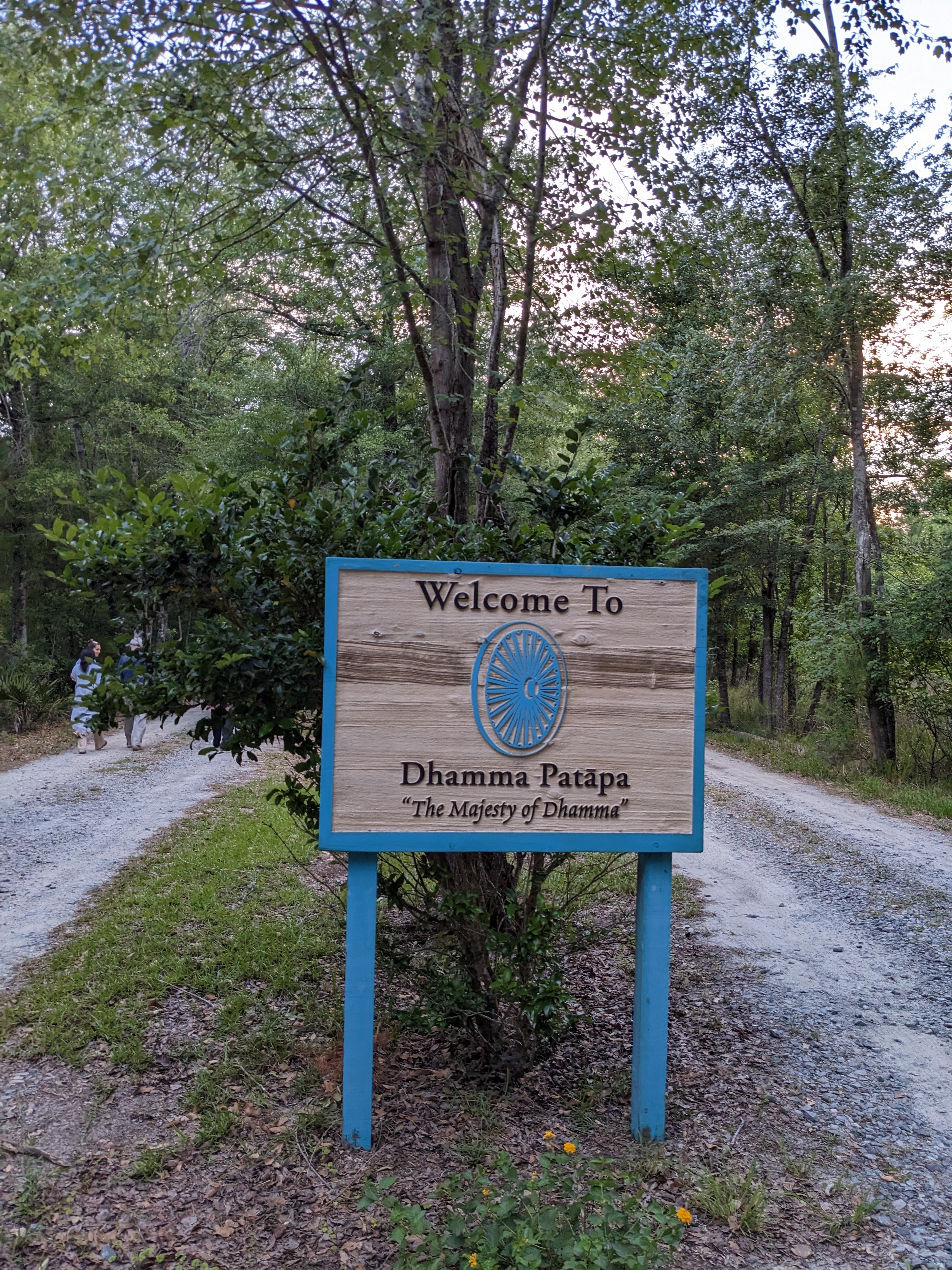
I asked around and found out that this intense and cultish-sounding course was called Vipassana. I was not prepared for it to be so competitive to register. I mean, who in their right mind would actually want to go through with this? A lot of people, apparently. I had to log into the website and sign up at six am when registration opened a few months in advance of the course. I was very, very nervous. I had no idea what to expect. I carpooled with two others coming from Atlanta. We drove for four hours along rural two-lane highways deep in the countryside of Georgia. It was the end of September. Not too hot, not too cold. We had pillows and cushions and sleeping bags and it felt like we were going to a meditation summer camp.

I pulled up and was greeted by the course manager, Natalie. I was expecting everyone involved to be serene. In a blissful, calm state of enlightenment. This was not the case. Her heart was in the right place, but Natalie had an almost off-putting bubbly energy. She greeted me and completely unprompted, told me a lengthy story of how she got her name, chatting away as she gave me directions to my room. I unloaded my things from my car, settling in slowly before dinner, as there was nothing else for me to do. No phones, no music, no reading, no writing. The daily schedule was posted on the wall by the bed.

| 4:00 am | Morning wake-up bell |
| 4:30-6:30 am | Meditate in the hall or in your room |
| 6:30-8:00 am | Breakfast break |
| 8:00-9:00 am | Group meditation in the hall |
| 9:00-11:00 am | Meditate in the hall or in your room according to the teacher’s instructions |
| 11:00-12:00 noon | Lunch break |
| 12 noon-1:00 pm | Rest and interviews with the teacher |
| 1:00-2:30 pm | Meditate in the hall or in your room |
| 2:30-3:30 pm | Group meditation in the hall |
| 3:30-5:00 pm | Meditate in the hall or in your own room according to the teacher’s instructions |
| 5:00-6:00 pm | Tea break |
| 6:00-7:00 pm | Group meditation in the hall |
| 7:00-8:15 pm | Teacher’s Discourse in the hall |
| 8:15-9:00 pm | Group meditation in the hall |
| 9:00-9:30 pm | Question time in the hall |
| 9:30 pm | Retire to your own room–Lights out |
We were strictly separated by gender for the entire duration of the course, which I found off-putting and heteronormative. Men and women had separate dining halls and walking paths, and entered the meditation hall from two different entrances. As a pansexual, if I’m being distracted by nice butts on my path to enlightenment, shouldn’t everyone?

The gong, which would quickly become a familiar sound, signaled that it was time for dinner, a simple vegetarian meal. It also served as our alarm clock in the morning, when it was time to meditate, when meditation was over, and when it was time to go to bed. Not everyone had arrived at the meditation center yet. Those of us who had gathered together in the dining hall and nervously asked each other, is it your first time too? Hoping that someone could tell us what we were actually in for. After dinner we were lined up in order of the seating chart to enter the meditation hall. Once seated inside, we were solemnly instructed to say the five “precepts” or code of conduct we were to follow for the duration of the course.
- to abstain from killing any being;
- to abstain from stealing;
- to abstain from all sexual activity;
- to abstain from telling lies;
- to abstain from all intoxicants.
Every night was movie night at Vipassana meditation camp. The “teacher’s discourse” was an old video from the 90s of S. N. Goenka, who popularized Vipassana-style meditation outside of Myanmar (Burma). It was a different video every night. He would talk to us about what we were doing and why. His wife sat silently next to him in every video. She had married him when he was a successful businessman. Now she had spent thousands of hours of her life meditating because of him, and I wondered how she felt about it.
The next morning, technically day one, the gong sounded faithfully at 4 a.m. For the first meditation of the day we had the option to meditate in our room or in the hall. I didn’t trust myself to not fall back asleep so I headed to the meditation hall. Several people were already gathered outside, waiting to be let in. I joined them and we waited until someone came and went directly into the meditation hall, which had been open the entire time.
Under any other set of circumstances, we would have looked at each other and laughed to acknowledge the situation. But we were not supposed to interact with each other at all. There was to be no communication among students, which included gesturing and writing. So we stoically filed inside. I sat there, wondering what the hell I was doing here and still unsure as to what Vipassana meditation actually is.

The first two days were absolute torture. It was unbearable boredom to the point of agony. Truly awful. My body hurt all over from sitting with no back support for so many hours. I got headaches. A recording of S. N. Goenka chanting started and ended each meditation session in the hall. Every now and then he would give us instructions. Focus on your breathing. Just observe. Focus on the space between your upper lip and your nostrils. Just observe. Gently bring your awareness back to the present moment, and observe.
In the meditation hall, someone would cough or sneeze and my mind would latch hungrily onto the interruption, always coming up with some narrative. Sometimes someone would start crying and I would immediately start making up wild guesses as to why. Anything to avoid doing nothing.
These first couple of days were just preparation, in order to “calm our minds.” Focusing on the breath was a tool to become aware of the spastic, endless chatter that makes up an individual’s inner monologue from moment to moment. On day three, we finally learned the actual technique of Vipassana meditation, and the real torture began.
Continue reading Part Two.


Leave a Reply